PeakLab
v2 Documentation Contents
R2N
Software Home
R2N
Software Support
BEADS Baseline
BEADS: Baseline Estimation and Denoising using Sparsity
BEADS represents a modern, non-convex optimization approach to signal
processing. Unlike Whittaker or morphological filters, BEADS performs simultaneous baseline correction
and denoising by decomposing the signal into three distinct physical components.
The Sparsity Model
The algorithm assumes the observed signal ($y$) is the sum of:
B (Baseline): A low-pass component representing slow, undulating drift.
P (Peaks): A "sparse" component representing analytical peaks (non-zero only
in small regions).
N (Noise): High-frequency stationary white noise.
BEADS Parameter Overview
Fc (Cutoff Frequency): This is the most critical parameter. It defines the "speed
limit" for the baseline. A lower $Fc$ results in a stiffer baseline that ignores peaks, while a higher
$Fc$ allows the baseline to follow faster drift.
lambda_0 (Peak Sparsity): This parameter enforces the "sparsity" of the analytical
peaks. It ensures that the peak signal returns to exactly zero in the baseline regions.
lambda_1 (Baseline Slope): Penalizes the first derivative of the baseline. It prevents
the baseline from having sudden "steps" or steep jumps.
lambda_2 (Baseline Curvature): Penalizes the second derivative. It ensures the baseline
transitions are "graceful" and smooth, similar to the $\lambda$ effect in Whittaker smoothing.
Asym (Asymmetry): Since chromatographic peaks are unipolar (positive-only), this parameter
weights the penalty to prevent the baseline from "dipping" below the noise floor during peak
regions.
BEADS Parameter Interpretation
BEADS is a "Sparsity-based" approach. It doesn't just smooth; it attempts to decompose the signal
into components. Because it uses a non-convex solver, the five parameters are highly interactive.
|
Parameter |
Name |
Technical Role |
Practical Interpretation |
|
Fc |
Cutoff Frequency |
Defines the "speed" of the baseline. |
The most important parameter. It sets the frequency (cycles/sample)
below which the signal is considered "baseline." Lower Fc = smoother baseline. |
|
lambda_0 |
Denoising |
Weight of the Sparsity (Peaks). |
Controls how "clean" the peaks are. It forces the peak signal
to be zero in regions where there is no actual signal. |
|
lambda_1 |
Baseline Smoothness |
Penalty on 1st derivative of baseline. |
Similar to Whittaker's lambda, it prevents the baseline from having
"kinks" or sharp jumps. |
|
lambda_2 |
Baseline Curvature |
Penalty on 2nd derivative of baseline. |
Ensures the baseline has smooth transitions in curvature. Works with
lambda_1to keep the drift "graceful." |
|
asym |
Asymmetry |
Balances positive vs. negative peaks. |
Since chromatography peaks are positive-only, asym is used to ensure
the algorithm doesn't treat a negative dip (noise) the same as a positive peak. |
Usage Considerations
BEADS is ideal for high-noise environments where you wish to remove the baseline and "clean"
the signal in a single mathematical pass without distorting peak shapes. BEADS has been reported to be
highly effective for Raman spectral data and for complex LC-MS total ion chromatograms.
Optimization of Parameters
The BEADS algorithm's five parameters can be very challenging to tune and we strongly recommend that you
use PeakLab's baseline
genetic optimization to train BEADS to mimic your own human designed baseline. The BEADS algorithm
requires careful tuning of the filter cutoff frequency and the sparsity regularization parameters.
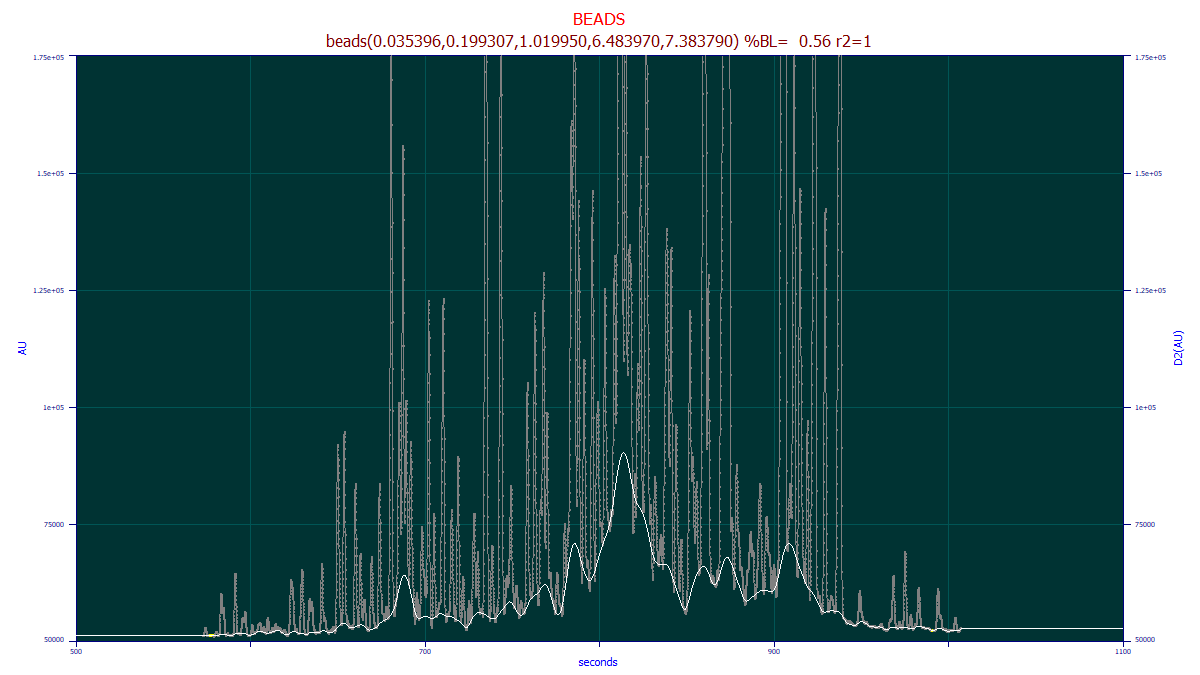
This is an example of a BEADS algorithm for a natural product GC separation where there is a raised
baseline. The BEADS optimization tracks the lower limits of the data in creating a rolling ball/convex
hull/rubber band kind of baseline. In natural product separations, the "raised baseline" is
often not an instrument artifact but a "forest" of unresolved trace peaks. BEADS is ideal here
because its sparsity model treats the forest as noise while the asymmetry identifies the true chemical
zero.
Comparison with Whittaker Fitted Baselines
|
Feature |
BEADS (Sparsity-Based) |
Whittaker (arpls/aspls) |
|
Physical Analogy |
Rubber Band / Convex Hull.
It "wraps" around the underside of the data. |
Stiff Wire / Spline.
It resists bending based on a global $\lambda$ penalty. |
|
Best For... |
High-frequency noise and baseline drift in Chromatography
and MS. |
Broad, overlapping peaks and shifting offsets in XPS
or Raman. |
|
Strength |
Superior at simultaneous
denoising and baseline correction. |
Exceptional at maintaining "rigidity" across wide peak envelopes. |
|
Weakness |
Can struggle with "wide" peaks if the frequency cutoff is
too low; acts too much like a "rolling ball". |
Does not handle high-frequency noise internally; requires pre-smoothing. |
Core References
Ning, X., Selesnick, I. W., & Duval, L. (2014). "Chromatogram baseline estimation and
denoising using sparsity (BEADS)." Chemometrics and Intelligent Laboratory Systems, 139, 156-167.